

Zakažite termin
+381 63 76 22 485Pozivi od 11:00h do 18:00h
Glavne lokacije
Nemanjina 5, Beograd | Albertstraße, Berlin
Why do we take our shoes off in therapy?

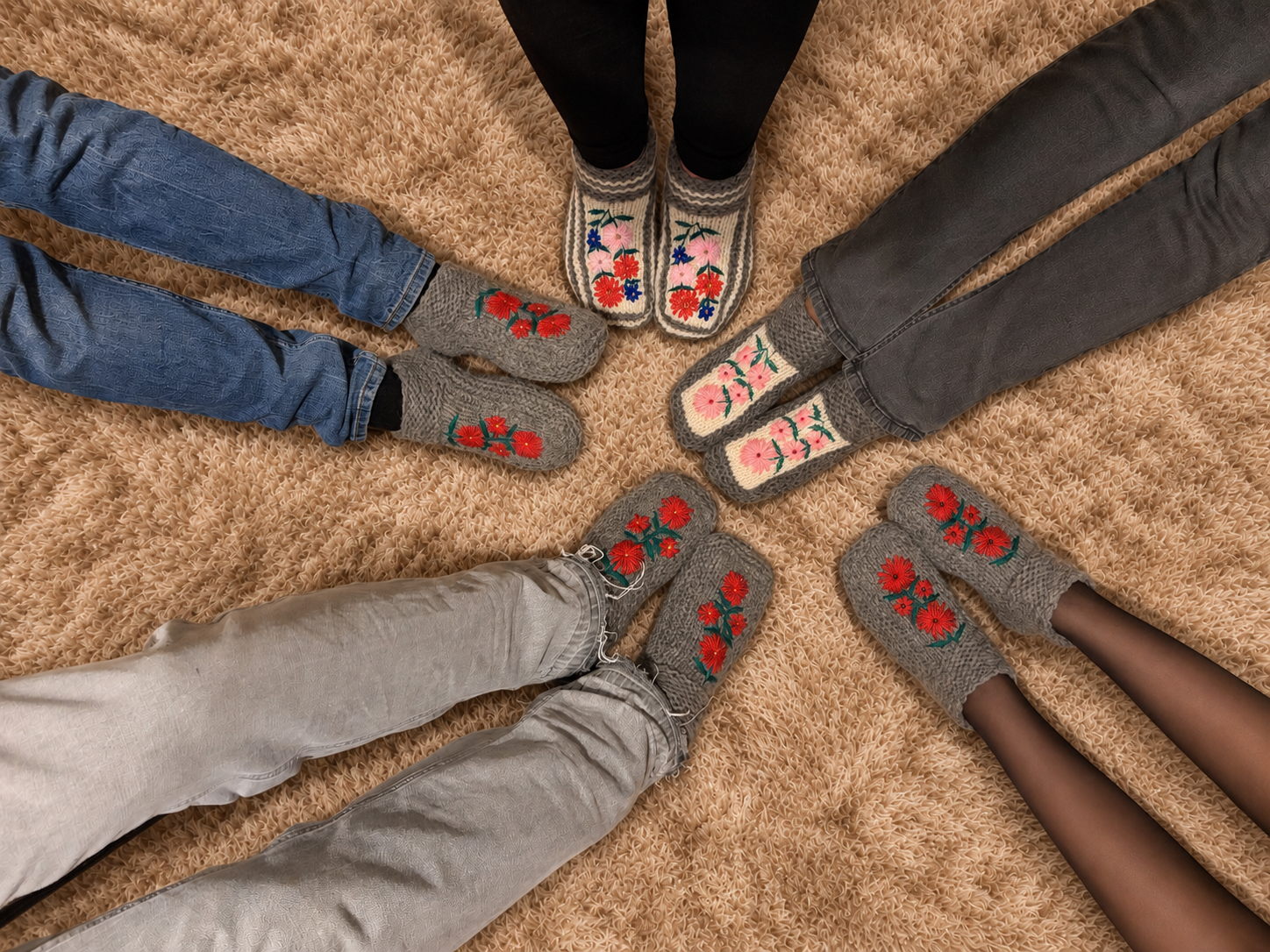
When you first come to us, we will ask you to take off your shoes. Having your shoes off in therapy is partly a practical matter: we want the space to stay clean, especially because body-oriented and group work happens on rugs, mats and the floor. But there is also something in that small step from the street into the room that is close to the way we work.
And let us say it right away: if taking your shoes off does not feel right, there are other options. You will find them near the end.
Shoes off in therapy: from the street into the room
We come to therapy with everything that has happened to us that day. With a conversation still running in our head, a message we have not answered, rush, tiredness. Sometimes we sit down and only after a few minutes notice that we are still clenching our jaw or holding our shoulders up, as if we were still trying to arrive on time.
So we leave our shoes at the door, and with them, at least a little, the street. This applies to everyone: we take ours off too, therapists as well, not only you. For us, shoes off in therapy is not a test and not a condition. It is a small, shared step from one rhythm into another.
The space is more than a backdrop
The room where therapy happens is not neutral. In their review of the physical environment of counselling, Pressly and Heesacker describe how light, sound, colour, furniture and layout influence what happens in the room.1
Taking your shoes off is one of those small signals: here nobody rushes, and you can settle in the way that feels right to you. Safety, choice and collaboration are among the core principles of a trauma-informed approach.2
A space does not need to be perfect. It needs to be safe enough for us to notice ourselves in it.
Feet, support and shoes off in therapy
In body-oriented work we sometimes turn our attention to very simple experiences: how we sit, where we feel the weight of the body, whether we hold our breath and how our feet touch the floor. Body psychotherapy often uses the word grounding for this: the sense that something holds us and that we have support.
Be aware of the contact between your feet and the Earth.
Thich Nhat Hanh, Peace Is Every Step (1991)What our feet actually “tell” the body
Our feet are an important source of sensory information. The skin of the sole holds four types of mechanoreceptors, receptors for touch and pressure. A review by Strzalkowski and colleagues describes the sole as a valuable sensory structure for keeping our balance while standing.3
In one study, people stood still with their eyes closed while researchers gently vibrated the soles of their feet. Every one of them felt their whole body leaning.4 Touch on the soles, then, takes part in how we experience the position of our own body, not only in how we keep it.
What shoes off in therapy does not promise
Our feet give us important information about the ground beneath us and help us keep our balance. When sensation in the soles is temporarily reduced, their contribution becomes more noticeable in more demanding conditions, for example when we stand with our eyes closed or on one leg.5 This research helps us understand the role of touch and support in balance. A sense of calm, however, is a separate question: taking our shoes off may feel good to some people and add to their comfort, but these findings do not show that it calms us by itself.
Shoes off as a small space for exploring
That is exactly why taking our shoes off can become a small space for exploring: how is it for us when we feel the ground under our feet, when we are without shoes in front of others, when something usually hidden becomes visible? For some it brings comfort, for some unease, and some barely notice anything. We can ask ourselves how much we accept our body, what we want to hide about it, and how much freedom we give ourselves to be comfortable, even when that means doing something differently from others.
None of this is a test of how relaxed we are, and no single gesture can “reveal” someone’s relationship with themselves. It is an invitation to notice our own experience: whether something feels good, whether we go along with it because it is expected, and whether we can say when we need something different. Accepting our body also includes the right to respect its boundaries, without demanding that we feel comfortable right away.
Myth or fact about shoes off in therapy?
The cards about shoes off in therapy turn when you click them.
Body awareness as a skill
In therapy we are interested in your actual experience: do you notice the floor under your feet, how do you distribute your weight, and would it feel good to change position? Can you find a way of sitting that is at least a little more comfortable? And if you cannot, can you recognise what bothers you and say what you need?
From there, attention can also turn to inner signals: breathing, heartbeat, hunger, warmth or tightness in the stomach. The ability to notice these signals, and the way we relate to them, are part of interoceptive awareness. It covers more than simply registering sensations. The MAIA questionnaire, developed by Mehling and colleagues, distinguishes eight dimensions of this experience, among them regulating attention, connecting body sensations with emotions, and trusting one’s own body.6
Noticing without pressure
This is an important difference: we can feel our body very intensely and still experience it with fear or mistrust. So the aim is not to keep tracking every sensation, but to gradually build a relationship in which we can notice what is happening inside us, without pressure to change it right away.
Price and Hooven describe how the skills of noticing and understanding body signals can be developed gradually as a support for emotion regulation.7 When stress, pain or traumatic experiences make contact with the body difficult, it matters that the pace stays bearable. Sometimes the beginning is very small: noticing the support beneath us, moving our feet, or allowing ourselves a more comfortable position. And noticing when, for now, it is enough.
What it looks like in the room
Shoes off in therapy can be a small invitation to notice how we feel in the space, in our own body and in the presence of another person. Sometimes it looks very simple:
We do not have to find an explanation right away. We can stay with that experience and explore whether sitting just like that suits you, or whether you would like to try something different. Maybe you will lean back and feel relief. Maybe leaning back will feel more uncomfortable. Both have a place in the conversation.
In everyday speed it is easy to miss how much we strain to seem composed, to speak sensibly or to take up as little space as possible. Sometimes only when we move our legs do we notice we have been holding them tense the whole time. Then we can also explore what we need: more support, a different position, a little more distance, or the freedom to move without explaining.
Words and body, together
No posture has a predetermined psychological meaning. We explore its meaning together, through your experience and what happens between us.
Linking conversation with bodily experience is an important part of body psychotherapy (in Serbian). A meta-analysis by Rosendahl and colleagues supports its effectiveness in reducing psychological symptoms and distress.8
Somatic Experiencing (in Serbian) also involves careful work with body sensations; a randomised trial by Brom and colleagues showed promising results in easing symptoms of posttraumatic stress.9
Trauma is a fact of life. It does not, however, have to be a life sentence.
Peter A. Levine, Waking the Tiger (1997)These findings refer to therapeutic approaches as a whole. In the room, however, we start from what is possible for you in that moment: to notice something, to check what feels good, and to have room to say when you need something different.
Read more (in Serbian)What body psychotherapy sessions look likeComfort looks different: shoes off in therapy, your way
For some people, taking their shoes off feels good straight away. They move their feet more freely, tuck their legs up or settle in more comfortably. For others, being without shoes in a space they do not know yet feels uncomfortable. They may feel shame, cold or exposed. Or they may simply be more comfortable in shoes. That experience does not need a deeper explanation to deserve respect.
When we need time to relax
In a new space we may be more cautious: paying more attention to the person across from us, to sounds from the hallway or to how far we are from the door. Sometimes we notice tension, faster breathing or a need to move. Sometimes we go quiet and stay almost still.
When we experience a threat, defensive responses such as fight, flight or freeze can be activated. Karin Roelofs describes freezing as an active stopping of movement that can support perception and the preparation of the next response.10 Still, discomfort about taking shoes off is not enough reason to conclude that someone is in such a state. What matters more is hearing how that person actually is.
In therapy there is room for caution and for mistrust too. A sense of safety can be built gradually through the experience of being listened to, having your pace respected and having what does not feel right taken seriously. Being able to say “This isn’t comfortable for me” without having to justify yourself helps with that too.
It would be rather paradoxical if your very first therapy session greeted you with a request to feel relaxed.

Shoes off in therapy: what you can choose
In our space we swap the shoes we wear outside for socks or slippers, and if taking your shoes off does not suit you, you can use shoe covers. You can choose:
- Socks, it is perfectly fine to stay in them.
- Your own slippers, feel free to bring them.
- Our knitted wool slippers, which we wash regularly.
- Shoe covers, if you would like to keep your own shoes on.
The same rule applies at Nemanjina 5 and at Francuska 16. If you need an adjustment, just tell us. You do not have to justify your need for us to take it seriously.
The curious paradox is that when I accept myself as I am, then I change.
Carl Rogers, On Becoming a Person (1961)What feels uncomfortable also belongs to the relationship
From the very first visit we meet the way a space is arranged, with its rules and expectations. For some people it is easy to ask for another option. Some adapt almost automatically and only later notice that something did not feel right. Some think: “If I say this bothers me, will I seem demanding?” or “Is there room for me here even when something doesn’t suit me?”
Such questions can have their own history. If we once had to push discomfort down to keep closeness, we may, in a new relationship too, first check what the other person wants from us. If our needs were met with mockery, anger or withdrawal, it can be hard to believe that someone will hear them differently now. This sometimes happens before we consciously recognise what we expect.
But we do not assume that taking your shoes off has that meaning for you. Maybe you are simply cold. Maybe your foot hurts or you do not like shared slippers. We do not decide the meaning in advance; if it matters to you, we discover it together.
What do we expect to happen if we say “no”?
In therapy we may also be interested in what happens between us when you express a need or disagreement. Do you expect me to get angry? That you will have to convince me? That I will accept it on the surface but actually think you are difficult? Perhaps it is easier for you to put up with a small discomfort than to risk a change in how I relate to you.
These are not questions you have to answer at the door. They only become meaningful if they appear in your experience and if you want us to explore them.
My actual response matters too. Not everything you feel is just an echo of earlier relationships. I may have said something too quickly, sounded strict or not offered a choice clearly enough. As a therapist, I have a responsibility to consider my own part in what happens between us.
A relationship where difference can be spoken
Trust is also built in small moments when we check whether the relationship can hold different needs. You say something does not suit you, and the other person stays interested, without persuading or withdrawing. Or at first we misunderstand each other, and then manage to pause and come back to it.
For some people this is a new experience: being able to express dissatisfaction without losing closeness; accepting a frame without giving up on themselves. For others it matters to discover that adapting can be their free choice, without feeling defeated or subdued.
That is why it matters to us that there is room for your “yes”, “no” and “I don’t know yet”. We do not have to resolve every discomfort right away. We can first understand it.
Recovery can take place only within the context of relationships; it cannot occur in isolation.
Judith Herman, Trauma and Recovery (1992)You do not have to be a “pleasant” client to deserve a careful relationship. You can be unsure, dissatisfied, cautious or of a different opinion, and we can stay in the conversation with that.
Frequently asked questions about shoes off in therapy
Do I have to take my shoes off?
We swap the shoes we wear outside for socks or slippers. If taking your shoes off does not suit you, you can keep your own shoes on with the shoe covers we have for you. You do not have to be barefoot.
Why is shoes off in therapy a rule here?
For the hygiene of a shared space, because body-oriented and group work happens on rugs, mats and the floor. It is a practical rule; how you experience that rule is something we can talk about.
Will the therapist read something into it if I don’t want to take my shoes off?
We will not draw conclusions about your personality, trust or readiness for therapy from it. If the situation stirs something important for you, we can explore it together. You can also simply ask for shoe covers.
Do therapists take their shoes off too?
Yes. The rule applies to everyone using the space, including therapists.
Does the rule apply in both spaces?
Yes, at Nemanjina 5 and at Francuska 16 in Belgrade.
What if I don’t say that something bothers me?
You can tell us later too. You do not have to recognise your need right away or find the perfect words. Even the sentence “Last time I went along with it, but it didn’t actually feel comfortable” has its place in therapy.
For a deeper look at trauma work through the body: Somatic Experiencing therapy (in Serbian).
This text is psychoeducational and does not replace an individual assessment or professional help. If things feel hard, please reach out to a professional you trust, or to us.
Literature and further reading
Space and safety
- Pressly, P. K., & Heesacker, M. (2001). The physical environment and counseling: A review of theory and research. Journal of Counseling & Development, 79(2), 148–160. https://doi.org/10.1002/j.1556-6676.2001.tb01954.x
- Substance Abuse and Mental Health Services Administration. (2014). SAMHSA’s concept of trauma and guidance for a trauma-informed approach (HHS Publication No. SMA 14-4884). store.samhsa.gov
Feet and the sense of body position
- Strzalkowski, N. D. J., Peters, R. M., Inglis, J. T., & Bent, L. R. (2018). Cutaneous afferent innervation of the human foot sole: What can we learn from single-unit recordings? Journal of Neurophysiology, 120(3), 1233–1246. https://doi.org/10.1152/jn.00848.2017
- Roll, R., Kavounoudias, A., & Roll, J.-P. (2002). Cutaneous afferents from human plantar sole contribute to body posture awareness. NeuroReport, 13(15), 1957–1961. https://doi.org/10.1097/00001756-200210280-00025
- Meyer, P. F., Oddsson, L. I. E., & De Luca, C. J. (2004). The role of plantar cutaneous sensation in unperturbed stance. Experimental Brain Research, 156(4), 505–512. https://doi.org/10.1007/s00221-003-1804-y
Body awareness and body psychotherapy
- Mehling, W. E., Price, C., Daubenmier, J. J., Acree, M., Bartmess, E., & Stewart, A. (2012). The Multidimensional Assessment of Interoceptive Awareness (MAIA). PLoS ONE, 7(11), e48230. https://doi.org/10.1371/journal.pone.0048230
- Price, C. J., & Hooven, C. (2018). Interoceptive awareness skills for emotion regulation: Theory and approach of Mindful Awareness in Body-Oriented Therapy (MABT). Frontiers in Psychology, 9, 798. https://doi.org/10.3389/fpsyg.2018.00798
- Rosendahl, S., Sattel, H., & Lahmann, C. (2021). Effectiveness of body psychotherapy: A systematic review and meta-analysis. Frontiers in Psychiatry, 12, 709798. https://doi.org/10.3389/fpsyt.2021.709798
- Brom, D., Stokar, Y., Lawi, C., Nuriel-Porat, V., Ziv, Y., Lerner, K., & Ross, G. (2017). Somatic Experiencing for posttraumatic stress disorder: A randomized controlled outcome study. Journal of Traumatic Stress, 30(3), 304–312. https://doi.org/10.1002/jts.22189
The nervous system
- Roelofs, K. (2017). Freeze for action: Neurobiological mechanisms in animal and human freezing. Philosophical Transactions of the Royal Society B: Biological Sciences, 372(1718), 20160206. https://doi.org/10.1098/rstb.2016.0206